Best AI Video Model for Game Sprites in 2026: Seedance vs Veo vs Kling vs Grok
Picking a video model for sprite work is a different question than picking one for a cinematic short. You do not care about a slow dolly across a sunset. You care about one thing: can it hold a character's design steady through a short, loopable motion on a flat background? That filter throws out most of the generic "best AI video" advice, so here is the 2026 lineup judged only on how useful it is for turning a clip into sprite frames.
First, the elephant: Sora is gone
If you came here looking for Sora, that ship has sailed. OpenAI shut the Sora app down on April 26, 2026, and turned off the API on September 24, after announcing the wind-down back in March. The reasons were the unglamorous ones: the compute bill (reported at around 15 million dollars a day) and the legal fog around training data. Sora 2 was genuinely impressive while it lasted, but that is academic now, because you cannot use it. Anyone still recommending it for a 2026 pipeline is reading from an old script. Move on.
Seedance 2.0 — the current benchmark king (with an asterisk)
ByteDance released Seedance 2.0 in February 2026 and it went straight to the top of the leaderboards. As of March it holds the number one spot for both text-to-video and image-to-video on the public Elo rankings, ahead of Kling 3.0, Veo 3, and Runway. For sprites the parts that matter are its motion consistency and its handling of short clips at up to 1080p. It is a unified multimodal model that takes an image as input, which is exactly the anchor you want for keeping a character on-model.
The asterisk: as of early 2026 it is restricted in the United States. It runs through APIs in more than 100 countries, but US-based devs are often reaching it through a third-party provider rather than directly. Sort out access before you build a workflow around it, because "the best model I cannot actually run" is not the best model for you.
Google Veo 3 — the dependable default
Veo is the one I reach for when I want a clean, controllable result without babysitting. It follows prompts well, holds a subject steady, and the quality at 1080p is reliably high. It is not topping the benchmark charts anymore, but predictable and high quality is underrated when you are generating ten takes to find one usable loop. For image-to-video character work it is a safe starting point, especially if you already live in the Google ecosystem.
Kling 3.0 — great motion, mind the drift
Kling has been a favorite in the character-animation crowd for a while, and 3.0 keeps it near the top. It produces lively, physical motion, which is good for run cycles and attacks where you want some weight behind the movement. The tradeoff is that it likes to interpret, so the design can drift a little more than Veo across a longer clip. Keep the clip short and the prompt tight and it is excellent.
Grok Imagine — fast, stylized, and handy for characters
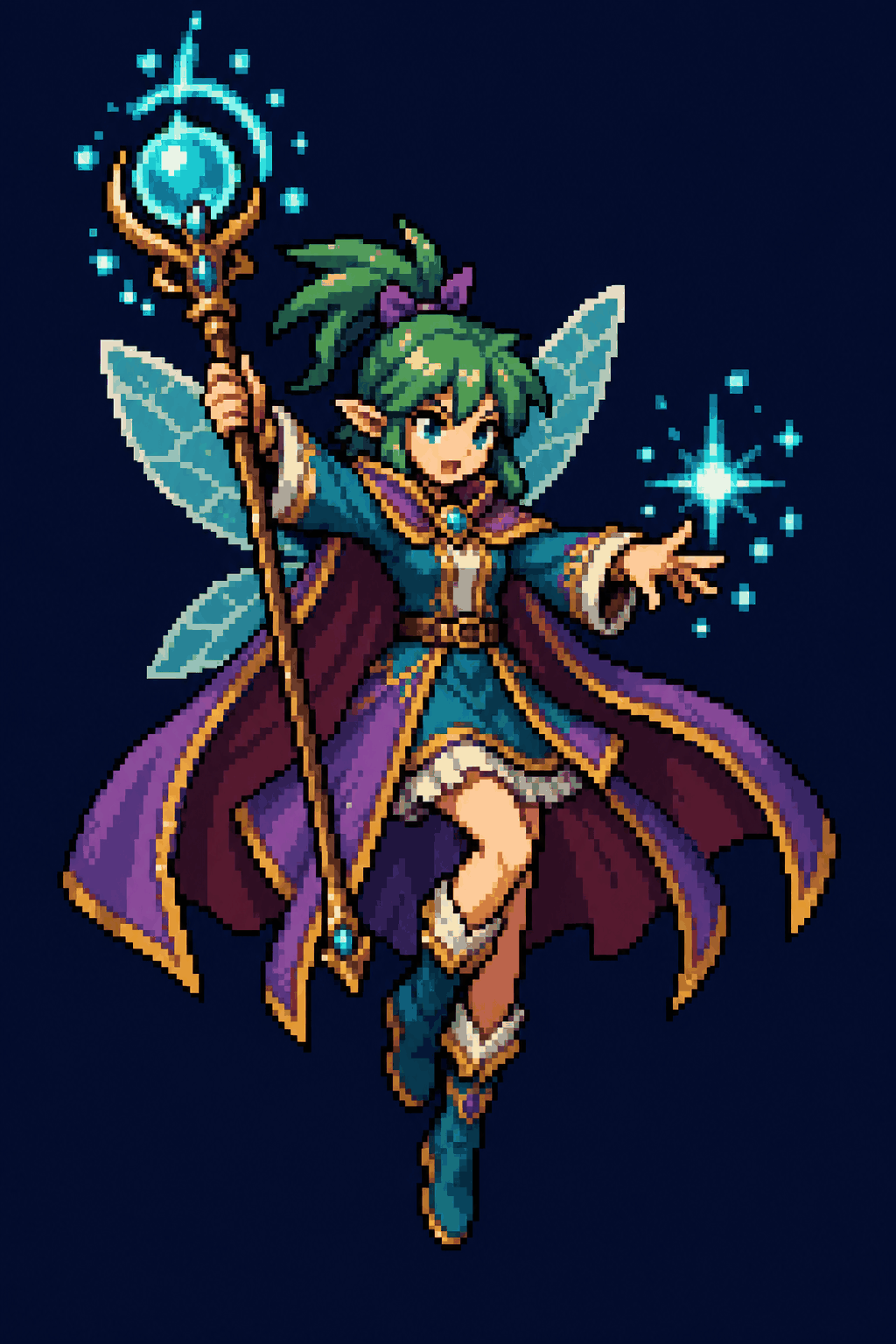
This is the one you may have been wondering about. xAI's Grok Imagine, powered by their Aurora engine, is not chasing the 1080p cinematic crown. Grok Imagine 1.0, from February 2026, does 10-second clips at 720p. What it is good at lines up neatly with sprite work: character generation, stylized and anime-leaning looks, and speed, with a clip landing in roughly 30 to 60 seconds. When you are pulling the slot-machine lever to find a good take, generation speed is a real feature, not a footnote.
The catch is resolution. 720p is fine if your sprite ends up 128 pixels tall, because you are downscaling hard regardless. It is a weaker starting point than Seedance or Veo if you want a larger sprite or fine detail. Treat Grok as the quick, characterful option, not the high-fidelity one.
Runway Gen-4.5 — for control freaks
Runway has leaned into control and editing rather than raw benchmark scores, which is a sensible bet for asset work. If you like fine-grained motion control and an editor that lets you nudge a result instead of rerolling it, Gen-4.5 is comfortable. It is no longer the leaderboard leader, but for directing motion precisely it holds up.
So which one?
Honest answer, sprite-first:
- Best raw quality and motion consistency: Seedance 2.0, if you can access it (mind the US restriction).
- Most dependable default: Veo 3.
- Liveliest character motion: Kling 3.0, with short clips.
- Fastest and most stylized, cheapest to iterate: Grok Imagine, especially for anime and character looks at small sprite sizes.
- Most control: Runway Gen-4.5.
Whichever you land on, the rules that make a clip usable as a sprite are the same. Prompt image-to-video from a fixed character still, force a static camera, ask for one cyclical motion on a flat solid background, and keep it short. The model hands you a clip; the loop and the frames are still your job. When you have a take you like, drop it into Sprite Frame Extractor, pick the loop range, drop to 12 to 15 fps, and pull the frames, all in the browser with nothing uploaded.
FAQ
Q. Can I still use Sora for game sprites?
No. OpenAI shut the Sora app down in April 2026 and the API in September 2026. Use Seedance 2.0, Veo 3, Kling 3.0, or Grok Imagine instead.
Q. Which model keeps a character's design the most consistent?
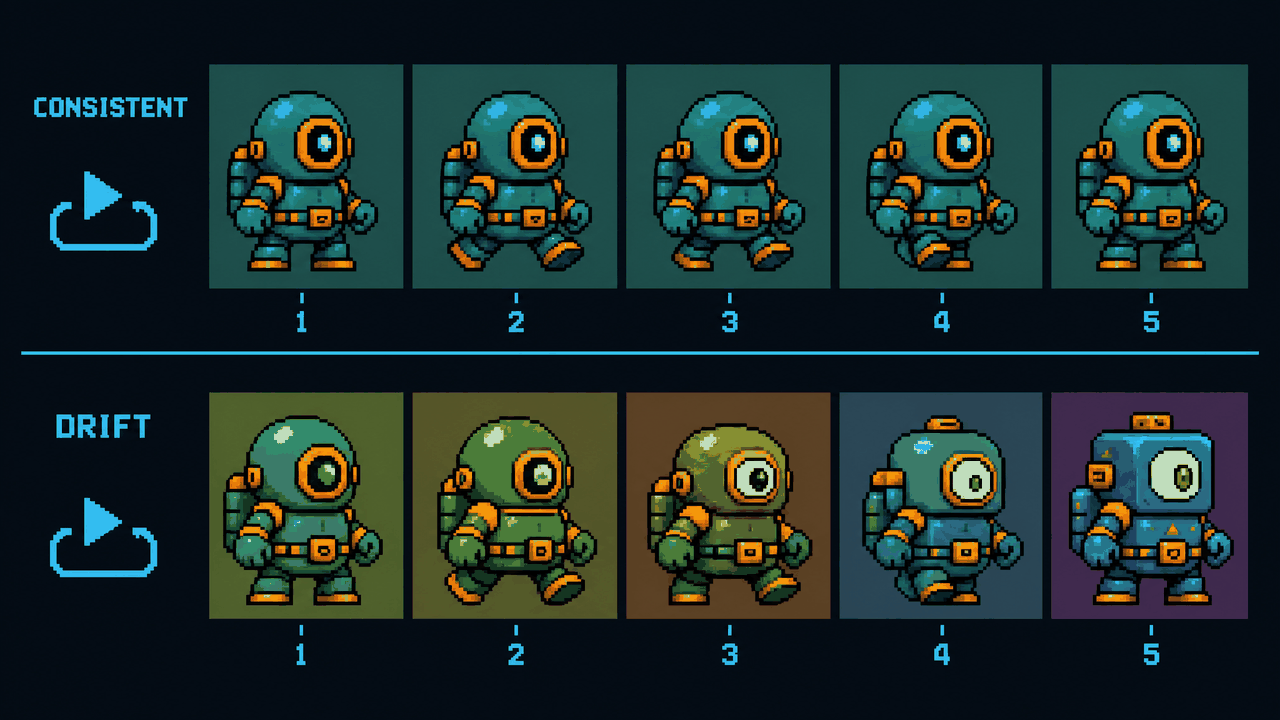
Image-to-video models anchored on a fixed still drift the least. Seedance 2.0 and Veo 3 are the strongest there in 2026. Whatever you use, keeping the clip short reduces drift.
Q. Is Seedance 2.0 available in the US?
As of early 2026 it is restricted in the United States, although it is available through APIs in over 100 countries. US developers often reach it through third-party providers.
Q. Does resolution matter if my sprite is tiny?
Less than you would expect. If you downscale to 64 to 128 pixels, a 720p source like Grok Imagine is fine. Higher-res models matter more for larger sprites or when you need detail before downscaling.